

Coaching: A Core Leadership Practice
Many leaders were promoted because they were strong individual performers. They know how to solve problems. They know how to move work forward. When they start managing others, they often keep doing the same thing. They solve problems themselves. They give quick answers. They give detailed instructions. Work gets done, but the team does not grow.
Coaching changes that pattern. Instead of being the person with the answer, you become the person who unlocks other people’s thinking. You still provide guidance and standards. You still make decisions when needed. But you also create space for others to understand the problem, weigh options, and commit to a plan. Over time this makes the whole group smarter and more capable.
Coaching is one of the most important skills a leader can learn. It is how you turn day to day work into ongoing personal and professional development. It is how you help people think more clearly, act more confidently, and grow faster. Coaching is not reserved for formal programs. It is a way of talking, listening, and asking that you can use in ten-minute conversations throughout the week.
Coaching does not require a special certification to begin. It requires intention, attention, and a few simple questions.
This article explains what coaching is, why it matters for leaders at all levels, and how to do it in a way that fits normal workloads. The aim is practical. By the end you should have a simple coaching pattern you can use in your next one on one or project conversation.
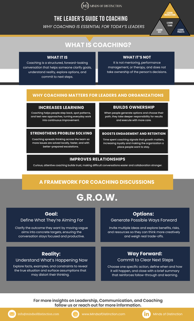
What Coaching is and what it is not
Coaching is a structured conversation that helps someone clarify a goal, understand the current situation, explore options, and commit to specific next steps. The coach is responsible for the quality of the thinking process, not for owning the decision. The person being coached remains responsible for their choices and actions.
A useful way to hold coaching in mind is this – Coaching is support plus stretch. You give support by listening, clarifying, and showing respect. You add stretch by asking questions that challenge assumptions, raise the standard, or widen the range of options.
Coaching is not the same as mentoring. A mentor often shares stories and advice based on personal experience. That can be valuable, but if it is the only move, it can create dependency. Coaching, by contrast, focuses on the other person’s thinking. You may share ideas, but you do so after you have helped them explore their own.
Coaching is also not the same as performance management. Performance management is about setting expectations, monitoring results, and addressing gaps. Coaching is about building capacity to meet expectations and handle future challenges. In practice, good leaders use both. They are clear about standards, and they also help people grow toward those standards.
Another important distinction is between coaching and therapy. Coaching focuses on current work questions, goals, and behaviors. It does not diagnose or treat mental health conditions. When deeper issues arise, responsible coaches respect boundaries and encourage professional help when appropriate.
In short, coaching is a forward looking, work focused, learning oriented conversation that helps a person move from intention to action with more insight.
Why Coaching matters for Leaders and Organizations
There are several reasons coaching is worth the effort, especially at senior levels.
First, coaching increases learning from experience. People do not learn as much as they could simply by doing their job. They learn more when they step back, name what happened, see patterns, and test new approaches. Coaching creates that reflection in the flow of work. Research on deliberate practice and expertise shows that structured feedback and reflection are key to improvement.
Second, coaching increases ownership. When people are told exactly what to do, they may comply, but they do not fully own the solution. When they generate options, weigh trade offs, and decide, they feel more responsible for the result. That sense of ownership often leads to higher effort and more careful execution.
Third, coaching strengthens problem solving. Modern work is too complex for one person to see everything. If all thinking is done at the top, the system is fragile and probably slow. Coaching spreads problem solving skills across the team. Over time, more issues can be handled locally and faster. Escalation occurs less and becomes more thoughtful and prepared.
Fourth, coaching supports retention and engagement. People want to grow. When leaders invest time in coaching, they signal that development matters. That signal builds loyalty and makes the organization a more attractive place to stay and contribute.
Fifth, coaching improves relationships. Coaching requires real listening. It requires curiosity about another person’s view. This kind of attention builds trust. When hard conversations are needed later, that trust makes them easier to navigate.
Finally, coaching improves leader effectiveness. Leaders who coach free themselves from being the only solver. They gain time and cognitive space for strategic thinking. They also build successors who can step into larger roles.
GROW Framework for Coaching Discussions
There are many coaching models in the literature. One simple pattern works well in most settings. It can be remembered with four words. Goal, Reality, Options, Way forward (GROW). Variants of this pattern have been used widely in coaching research and practice.
1) Goal: Clarify what they are trying to achieve
Start by asking what they want from the conversation and from the situation itself. Examples: What would you like to be different by the end of this meeting? What outcome are you aiming for in this project? How will you know you have succeeded? These questions help the person focus. Without a clear goal, it is easy to wander in complaints or abstract talk.
Stay with goals long enough to move from vague to concrete. If someone says, I want this project to go better, ask, ‘What does better look like in three months? How would you describe success to someone who is not close to the work?’ This makes coaching more productive because it sets a target for decisions.
2) Reality: Understand the current situation
Once there is a goal, explore what is happening now. Ask for facts, not only opinions. What has been tried so far? What happened? Who is involved? What constraints are real and which are assumed? Ask for examples. Ask for timelines. This step helps avoid solutions that ignore key facts.
Leaders can add value here by gently testing assumptions. For instance, you might say, You mentioned that this group never responds on time. Can you think of times they did respond on time? What was different then? Questions like this help the person see patterns and avoid all or nothing thinking.
3) Options: Generate and explore possible ways forward
After the goal and current reality are clear, shift to options. Ask, ‘What could you do?’ Invite multiple ideas, even small ones. Many people stop after two or three obvious options. Encourage them to find a few more. You can say, ‘If you had to list five possible moves, even imperfect ones, what would they be?’ This widens creative thinking.
Then explore each option briefly. What is the likely benefit? What is the risk? What resources would it need? What is under your direct control and what is not? The aim is not to create a perfect answer, but to help the person think more deeply about trade-offs. This enhances critical thinking.
You can share your own ideas, but do it after they have explored theirs. When you share, frame your ideas as curious additions, not corrections. For example, ‘One option I see is to schedule a short expectations meeting with both groups. How does that land with you?’ This keeps them in the driver’s seat.
4) Way forward: Agree on specific next steps
The conversation only becomes coaching when it leads to action. Ask, ‘Given everything we have discussed, what is the next step you want to take?’ Help them make it specific. When will you do that? What will you say? Who needs to know? What could get in the way? How will you handle that?
Encourage small steps that can be taken soon. Big plans are harder to execute. A simple move done this week is usually better than a complex plan that remains on paper.
Close the conversation by summarizing. Today you clarified that your goal is X. You described the current situation as Y. You considered options A, B, and C. You chose to do B by Thursday. You will let me know what you see and we will revisit next week. This summary reinforces action and learning.
Coaching in different time frames
Not every coaching conversation has the same length. Leaders can adjust the depth while keeping the structure.
In three minutes. Ask, What are you trying to do. What have you tried. What will you do next. This is a quick coaching move in a hallway or short check in.
In fifteen minutes. Use the full pattern. Goal, current reality, options, next step. This works well in regular one on ones.
In sixty minutes. You can add reflection on patterns. You can explore strengths and values. You can connect the issue to long term development.
Coaching with different levels of experience
With new staff, you may need to offer more time and more support. You can ask questions and also share more examples and templates. The coaching focus is on building basic skills and confidence. With new staff you are also working to build trust.
With experienced staff, you can stay longer in questions and push for deeper analysis. You can ask, ‘What is the pattern you see across these three situations? What does that tell you about how you approach conflict, planning, or delegation?’
In both cases, the principle is the same. Help the person do as much of the thinking as they can and provide support where needed.
Common coaching pitfalls and how to avoid them
There are patterns that weaken coaching. Naming them helps you avoid them.
Turning coaching into a hidden evaluation. If people feel they are being judged, they will try to give the right answer instead of their real thinking. Fix this by being explicit. Say, This is a coaching conversation. We are here to explore options, not to grade your performance.
For some individuals and organizations – it’s much better to have an outside organization providing coaching to avoid this problem. Outside support reinforces that it is for the individuals benefit (organization as well of course) without the pressure of performance. When you remove this stressor – individuals can trust and build from the coaching faster. Strong leaders know this is true and seek outside coaches for their people for this exact reason.
Talking too much. Many leaders fill silence with advice. Fix this by counting to three before you speak. Let the other person think. Keep your own contributions shorter than theirs. Alternatively, make sure you are asking more questions than providing answers.
Jumping to stories about your own experience too early. This shifts the focus away from their situation. Fix this by waiting until later in the conversation and checking first. Would it be useful to hear a similar situation I faced?
Trying to coach when a direct decision is needed. Some situations require clear direction. Coaching works best when there is room for choice. Leaders can say, ‘In this case, I will decide because of time or risk. Afterward, we can use coaching to learn from it.’
Holding coaching only for high performers. Everyone can benefit from coaching, though the focus may differ. Limiting coaching to a few people can create perceptions of favoritism. Another reason why outside coaches are beneficial – it provides equal access to all parties.
What’s the IMPACT of Coaching?
The impact of coaching shows up in several ways.
You will hear different questions. People will bring you better framed problems. Instead of saying, Everything is a mess, they might say, ‘Here is the goal, here is what is happening, here are two options I see. Which do you prefer, and what am I missing?’ This is a sign that coaching is working.
You will see more initiative. People will start small experiments without waiting for perfect plans. They will report back on what they learned. This builds a cycle of learning.
You may see smoother delegation. Coaching fits well with clear delegation. You assign outcomes and decision rights, then use coaching to support the person in meeting those outcomes.
You will see more creative and critical thinking. People will share more about how they approached the problems instead of just giving the answer. You will see their growth – through their analysis of the situation, the options, the risks, and their recommendation.
You can also track some simple markers. For example, number of problems resolved at the team level without escalation, frequency of coaching style one on ones, and qualitative feedback on development from staff surveys or check ins.
Over time, you should experience less time spent on repeated problems and more time on long term work. That shift is one of the clearest signals that coaching is taking root.
Summary
Coaching is not a mysterious art. It is a learnable set of conversations. Leaders who coach well clarify goals, explore reality, widen options, and help people choose next steps. They listen more than they speak. They provide support and stretch. They turn daily work into a training ground for better thinking.
If you start with a few simple questions and repeat them, your team will notice. Over months, both performance and confidence will rise. Coaching is one of the most leverage rich habits you can add to your leadership practice to develop individuals and cultivate strong teams!
Citations:
Whitmore, J. (2009). Coaching for Performance. Nicholas Brealey.
Rock, D. (2006). Quiet Leadership. HarperCollins.
Ericsson, K. A., Krampe, R. T., and Tesch Römer, C. (1993). The role of deliberate practice in the acquisition of expert performance. Psychological Review.
Grant, A. M. (2014). The efficacy of executive coaching in times of organisational change. Journal of Change Management.
Boyatzis, R. E., and Smith, M. (2014). Coaching with compassion. Journal of Applied Behavioral Science.