

Receiving Feedback: Turn Input into an Advantage
Leaders talk a lot about giving feedback. Fewer talk about receiving it well. That is a gap. If you cannot receive feedback, you will not see blind spots. You will not grow as fast as you could. And your team will stop telling you the truth. This article is about the other side of the skill: how to receive feedback with clarity and calm, and then turn it into a concrete change.
Receiving feedback is hard because it touches identity. It can feel like a judgment, not a gift. The brain treats social threat much like physical threat. Heart rate rises. Focus narrows. We defend or explain. That is normal. And it is trainable. With a few habits, you can make feedback safer for yourself and more useful for the work.
What does “receiving feedback” actually mean?
Receiving feedback is a set of behaviors. You ask for input on a real piece of work. You listen for facts and effects. You separate the signal from the style. You ask questions until you can restate the point in your own words. You decide what you will change and when. Then you follow up so the giver can see that their effort mattered.
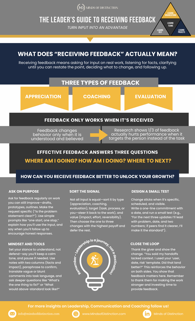
It helps to sort feedback by type. A simple trio works: Appreciation, Coaching, and Evaluation (Heen & Stone, 2014). Appreciation says “I see your effort or impact.” Coaching says “Here is how to improve.” Evaluation says “Here is where you stand vs a standard.” You need all three. The skill is knowing which one you are hearing, or which one you need, and steering the talk to fit.
Receiving well is not the same as agreeing. It is also not people‑pleasing. You can treat every piece of feedback as data without taking every suggestion as an order. Your job is to understand the signal, test it, and then decide.
Why it matters for performance and trust
Feedback changes behavior only when it is received, understood, and believed. Meta‑analysis shows that feedback can help or harm. In a classic review, about a third of feedback interventions actually reduced performance (Kluger & DeNisi, 1996). The difference was often the target. When feedback focused on the self, it backfired. When it focused on the task, the goal, and the next step, it helped.
Later work sharpened the point. Hattie & Timperley (2007) found that effective feedback answers three questions: Where am I going? How am I doing? Where to next? That frame helps receivers sort comments and ask better questions.
There is also a culture effect. Teams with psychological safety share more information and learn faster (Edmondson, 1999). Leaders who receive feedback with care and curiosity build that safety.
Finally, there is a career effect. You will not get perfect coaching every time. If you can extract useful signal from imperfect delivery, you grow faster than peers who wait for ideal conditions. That compounding matters over years.
How can you receive feedback better to unlock your growth?
You do not need a script for every case. You need a short checklist that covers most cases. Use these five parts: ask on purpose, listen with tools, sort the signal, choose one change, and close the loop.
1) Ask on purpose
Do not wait for annual reviews. Ask for feedback on real work on a regular cadence. Pick a piece of work where you can still change the outcome: a draft, a prototype, an outline, a plan.
Make the ask narrow. “Could you review the clarity of the problem statement?” is better than “Do you have any feedback?” Tie it to the three feedback questions: “Where am I going? How am I doing? Where to next?”
Use pull quotes to make it easy. “One thing to start, one thing to stop.” “What confused you?” “What would make this twice as useful?” Say how you will use the input and when you will follow up. That promise raises the odds you will get honest answers.
2) Listen with tools
Set your stance. Your goal in the meeting is to understand, not to defend. Say it aloud: “I will mostly listen. I want to be sure I understand.” Keep your tone slow and neutral. If you feel heat rising, note it. You can ask for a brief pause.
Use a pad or a shared doc. Label two columns: facts/evidence and effects/impact. Write exact quotes. Ask for examples. “Could you show me where that happens?” This keeps the talk on work, not worth.
Paraphrase often. “I hear that the opening jumps too fast and the risk is not clear. Is that right?” If the giver’s style is blunt or vague, translate it into task language. “So the change is: name the user, name the date, and show the before/after, is that correct?.”
Ask one level deeper. “If I fixed only one thing, what should it be?” “What are you comparing this to?” “What would ‘clearly above standard’ look like?” Good questions turn raw opinion into actionable guidance.
3) Sort the signal
Not all input is equal. Sort it three ways.
First: type – is this appreciation, coaching, or evaluation? If you asked for coaching but got evaluation, say so. “It helps to know where I stand. For this draft, I am also looking for two edits that would raise clarity.”
Second: target – does this point hit the task, the process, or me as a person? If it hits you, steer it to work. “I want to understand the work change. What would you like the next draft to do?”
Third: value – is the point high‑impact and feasible? Use a quick rubric: impact on outcome, effort to change, and reversibility. Pick the one to three items that score highest. Defer the rest.
4) Choose one change and design a small test
Change sticks when it is specific, scheduled, and seen.
Write one line: “By 2026, I will [behavior change] so that [outcome].”
Design a small test when possible. “For the next three status updates, I will lead with the problem, the date, and two numbers. If two peers say it is clearer, I will make that my standard.” Small tests reduce fear and make progress visible.
5) Close the loop
Thank the giver and show the change. “You said my handoffs lacked context. I used your ‘user, date, risk’ template. Did that land better?” This reinforces the behavior on both sides. You show that feedback matters here. Remember to thank them for making the work stronger.
Scripts you can borrow
Opening ask: “Could you give me coaching on the clarity of the problem statement? One thing to start and one thing to stop would help.”
During: “Let me play back what I heard to check if I got it right.” “Can you show me an example?” “If I fixed one thing, which one is the most important?”
When style is rough: “I want to understand the work change you are suggesting. Could we put it in terms of what to add, remove, or reorder?”
When you disagree: “Thank you. I see it slightly differently. I will test your suggestion on the next two cases and compare results.”
Closing: “Here is what I will change by Friday. I will send you an example so you can see if it hits the mark.”
Receiving hard feedback from people with less power
The most valuable feedback often comes from those who depend on you. People with less power carry more risk when they speak. If you lead others, you must lower that risk.
Invite dissent early. “If something I do makes your job harder, I want to hear it. I will thank you for telling me.” Show proof. Act on a small item fast. Publicly credit the source (with permission ahead of time).
Do not ask for “radical candor” and then punish it. Separate style from signal. Coach style later if needed. Start with the content.
Common pitfalls and how to avoid them
Fishing for praise. Fix: ask for coaching on one dimension of the work.
Collecting opinions without a decision. Fix: pick one change and schedule it.
Arguing the premise. Fix: restate the point and test it on the next two examples.
Treating style as signal. Fix: translate tone into task requests.
Letting it fade. Fix: send a follow‑up note with the change and date.
Summary
Receiving feedback is a leadership skill. Ask on purpose. Listen with tools. Sort the signal. Choose one change. Close the loop. Do this for two quarters and your work will improve. Your team will trust you more which will unlock more opportunities to invite feedback, gather useful input, and grow!
Citations:
Ramaprasad, A. (1983). On the definition of feedback. Behavioral Science.
Hattie, J., & Timperley, H. (2007). The Power of Feedback. Review of Educational Research.
Kluger, A. N., & DeNisi, A. (1996). The effects of feedback interventions on performance: A historical review, a meta‑analysis, and a preliminary feedback intervention theory. Psychological Bulletin.
Edmondson, A. C. (1999). Psychological Safety and Learning Behavior in Work Teams. Administrative Science Quarterly.
Heen, S., & Stone, D. (2014). Thanks for the Feedback: The Science and Art of Receiving Feedback Well.
Ericsson, K. A., et al. (1993/2018). Deliberate Practice and expert performance.
Zenger, J., & Folkman, J. (2014). Your Employees Want the Negative Feedback You Hate to Give. Harvard Business Review.