
Find Your Ikigai: A Practical Path to Meaningful, Sustainable Work
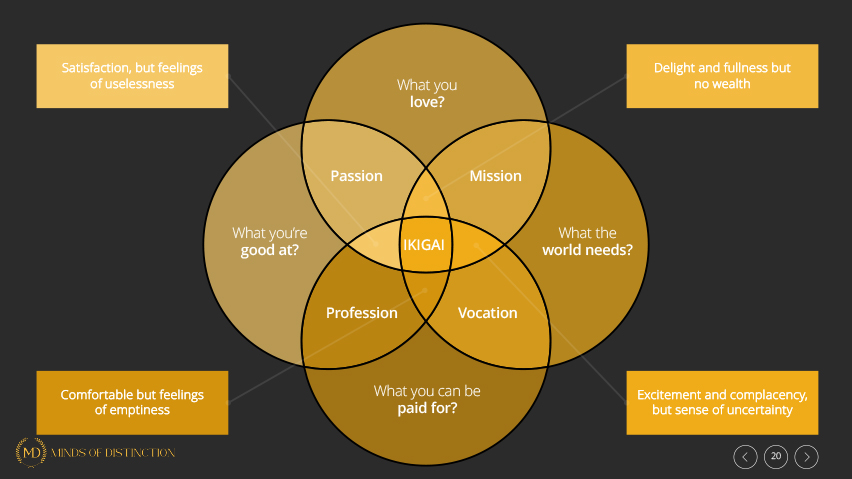
We all want work that feels energizing, pays the bills, serves a purpose, and taps our unique strengths. The Japanese idea of ikigai—“a reason for being”—sits at that intersection. Think of it as a simple, rigorous framework for designing a career you’re proud of. (Adapted from the classic four-circle diagram: what you love, what you’re good at, what the world needs, and what you can be paid for.)
The Four Questions That Change Everything
- What you love — the work that gives you energy even when it’s hard.
- What you’re good at — repeatable strengths, proven by outcomes.
- What the world needs — real problems, real stakeholders, real urgency.
- What you can be paid for — market demand and clear value exchange.
Where these overlap, you’ll find:
- Passion (love + strengths) — often fulfilling, but can lack financial viability.
- Profession (strengths + pay) — comfortable, yet can feel purposeless.
- Vocation (need + pay) — stable, but may underuse your gifts.
- Mission (love + need) — inspiring, but uncertain without a business model.
The goal isn’t to camp in one overlap—it’s to gradually integrate all four.
The Danger Zones (and How to Escape Them)
- “Satisfaction, but uselessness.” You’re competent and paid (profession), yet wonder if it matters. Add purpose.Shadow users or customers; connect metrics to human outcomes.
- “Comfortable, but emptiness.” The role pays and serves a need (vocation), but doesn’t fit your wiring. Add strengths. Redesign your responsibilities toward your spikes.
- “Delight and fullness, but no wealth.” You love it and you’re skilled (passion), but the market isn’t paying. Add business model. Package, productize, or reposition for a buyer segment.
- “Excitement with uncertainty.” You love it and it matters (mission), but you’re not yet great at it. Add deliberate practice. Invest in focused reps and feedback loops.
A Five-Step Ikigai Playbook
- Inventory your spikes. List 10 projects where you made a measurable difference. Circle the verbs—design, synthesize, mentor, negotiate, debug. Those are your strengths.
- Map the market. Identify 3–5 real problems you can solve within your domain. For each, write: who suffers, how they feel it, and the costly consequence of doing nothing.
- Design tiny experiments. Instead of a grand career leap, run two-week pilots: volunteer for a cross-functional task, ship a micro-feature, teach a workshop, test a service offering. Success metric: one concrete outcome per experiment.
- Close the gap that hurts most.
- If you lack pay, clarify the buyer and the outcome (e.g., “reduces cycle time by 30%”).
- If you lack need, move closer to the customer’s pain—observe, interview, co-build.
- If you lack love, swap 10–20% of your workload toward energizing tasks; protect that time.
- If you lack skill, pick one capability and schedule daily reps with feedback.
- Build an Ikigai Scorecard. Each week, rate 1–10 on Energy (love), Effectiveness (good at), Impact (world needs), Economics (paid). Track trends; adjust experiments accordingly.
For Leaders: Create Team-Level Ikigai
- Role-shaping: Let people spend at least 20% of time in their spike areas; rotate responsibilities to discover new ones.
- Impact narratives: Tie team metrics to real stakeholders—who’s safer, faster, better served because of your work?
- Skill lattices, not ladders: Offer multiple expert paths (technical, operational, customer, product) so people can grow without abandoning their strengths.
- Quarterly experiments: Fund small bets that align love/skill with validated needs; celebrate the learning, not just the wins.
Make It Real This Month
- Week 1: Write your spike inventory; ask three colleagues where you consistently add the most value.
- Week 2: Interview two “customers” of your work (internal or external). Capture their top pains in their words.
- Week 3: Run one two-week experiment aimed at relieving a specific pain using your spikes.
- Week 4: Review your Scorecard. Keep what gave energy and impact; kill or redesign the rest.
The Quiet Promise of Ikigai
Ikigai isn’t a lightning strike; it’s a rhythm. With each experiment, you close the distance between who you are and the work the world is asking of you. Over time, that rhythm compounds—into mastery, meaning, and a career that feels both true and useful.
If you’re looking for a sign to start, this is it. Begin with one conversation, one experiment, one week of intentional practice—and let the compound interest of aligned work do the rest.